Scott Carroll
       

About the Institute for Contemporary Evolution

Human activity is generating 'natural' selection across the planet, so much so that in organisms from microbes to trees, rapid evolution is becoming the new normal. Until recently it seemed that science progressed quickly while nature stood still, but now it seems the reverse is true.

In this new era in biology we can watch evolution in action. Evolutionary biology is the predictive core of all life science, and with evolution now occurring quickly and widely enough to be a practical matter, we can participate in its rise as an applied science.

Through its research, publications, and conferences, the ICE promotes new evolutionary approaches to the challenges of human sustainability in the areas of food, health, and the environment.

Things we do:

1. Evolutionary Conservation Biology

Carroll & Fox 2008
'The book deals with major issues that transcend taxonomic boundaries, has considerable potential to be widely used by graduate and undergraduate students, and constitutes an attractive reference for researchers interested in biodiversity conservation. As I have made evident, I hope, this book is motivational for future work.' –Excerpted from Rudolfo Dirzo, in Evolution (2009).
Conservation Biology is about much more than fighting extinction. In fact, many species that are persisting are doing so by adapting to changed circumstances. The conservation of evolving taxa differs from the approaches used in traditional static conservation models.

ICE Director Scott Carroll and Chuck Fox organized the volume 'Conservation Biology– Evolution in Action' to address this important issue. With 25 contributions from 35 authors, our goal is to integrate the two wings of Conservation Biology– one ecological, the other genetic– into their angelic union: Evolutionary Conservation Biology.

This books was published by Oxford University Press in September 2008.

Review by Rodolfo Dirzo in Evolution
Carroll & Fox (2008) Conservation Biology– Evolution in Action. Oxford University Press

2. International Summit: Interdisciplinary Solutions to Evolutionary Challenges in Food, Health and the Environment

Climate change, emerging disease, biotic invasion, and food security are principle concerns facing humankind. Far from being disparate problems, the challenges are largely biological in nature. The first step toward their long-term management and resolution is to integrate practical approaches in a common intellectual framework. Evolutionary theory provides the foundation for designing sustainable approaches.

The Heron Island Applied Evolution Summit will be held in January 2010. The program committee includes Scott Carroll, Mike Kinnison and Louis Bernatchez. Invitees include international experts, practitioners, stakeholders and policy makers in Food, Health, the Environment and Sustainability. Our goals are to develop eco-evolutionary modes for response to global change, cultivate the link between evolution and sustainable management, and create new partnerships for solving bio-based problems.

Applied Evolution Summit Web Page

3. Evolution on Ecological Timescales

Ecologically significant evolution, occurring over tens of generations or fewer, is now widely documented in nature. This finding counters the long-standing assumption that ecological and evolutionary processes occur on different time scales, and suggests new opportunities for integrative approaches to pressing questions in many fields of biology.

To further such approaches, along with colleagues Andrew Hendry, David Reznick, and Chuck Fox, we published an edited special feature in Functional Ecology (July 2007). The goals of this special feature were two-fold: to consider the factors that influence evolution on ecological timescales – phenotypic plasticity, maternal effects, sexual section, and gene flow – and to assess the consequences of such evolution – population persistence, speciation, community dynamics, and ecosystem function. Based on citation frequencies, the papers are generating interest.

Functional Ecology 21-3 (2007) Evolution on Ecological Time-scales

4. Adaptation to Global Change: the Soapberry Bugs

In this program we learn about coping with environmental change through the experiences of other living things. Invasive species (plants, animals etc. that establish and become abundant upon being introduced into new areas) are principle change agents around the planet. We focus on adaptation to invasive 'environmental weeds', introduced plants that, through their success, threaten the vitality and security of native species.

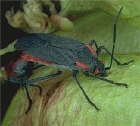
Soapberry bugs are good guides for this inquiry because they are widespread and easy to study. Through a combination of rapid evolution and flexibility, they have adapted to use a variety of environmental weeds in North America, Australia, and Africa. These bugs offer a real opportunity to study evolution in action, including the evolution of biological control value. Rapid evolution in the ability to exploit invaders may reduce our reliance on riskier conservations measures such as poisons and pest introductions.